AI Marketing SOPs for Scale — Miklos Roth


AI Marketing SOPs for Scale — Miklos RothAI Marketing SOPs for Scale — Miklos Roth
In the rapidly evolving landscape of digital business, the gap between potential and performance is often defined by process. While Artificial Intelligence (AI) promises to revolutionize how we work, the reality for many businesses is a chaotic implementation that leads to fragmented brand voices and inefficient workflows. The solution does not lie in more powerful tools, but in better governance of those tools. This is where Standard Operating Procedures (SOPs) tailored for the AI age become the critical differentiator for scaling enterprises.
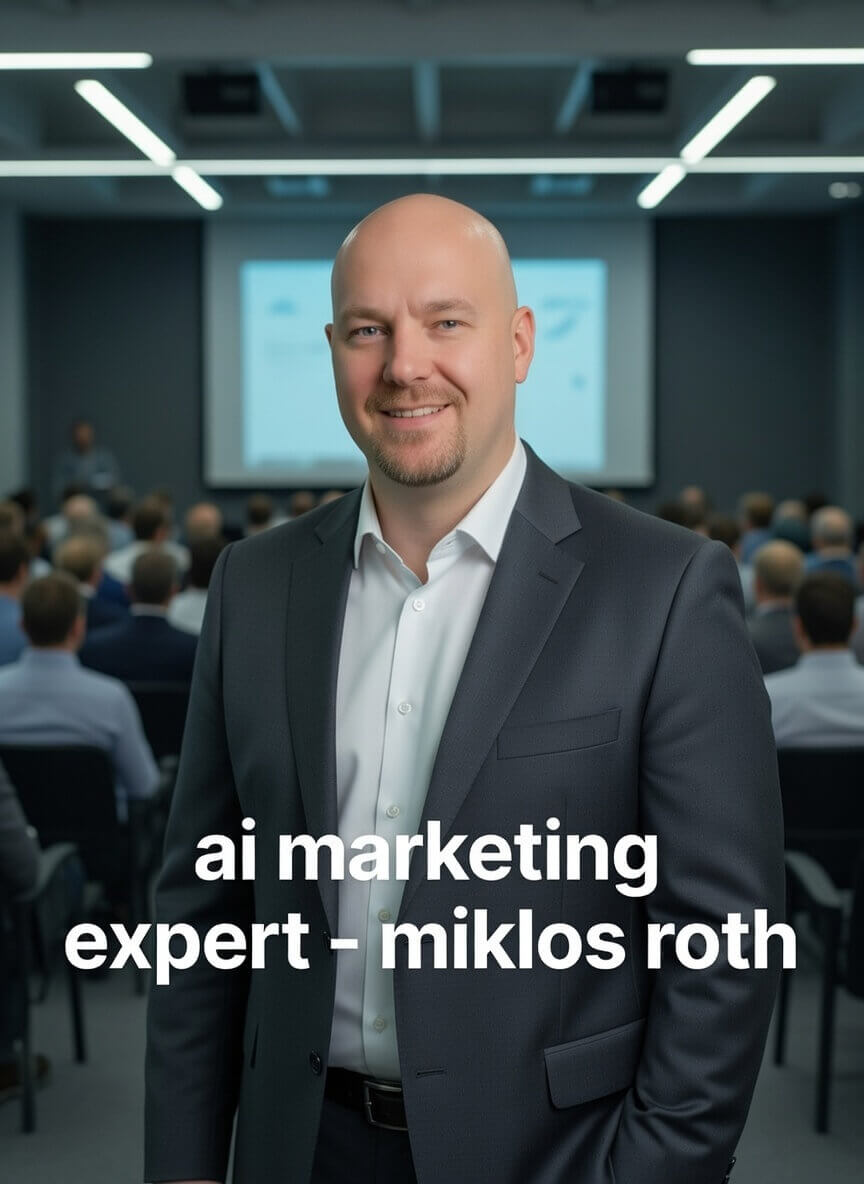
At the forefront of this operational shift is Miklos Roth, a strategist whose approach to digital transformation combines high-level academic rigor with the discipline of elite athletics. To understand how to scale marketing effectively using AI, one must look at the methodologies Roth has developed—specifically the transition from ad-hoc prompting to systemic AI integration.
The Intersection of Discipline and Digital Strategy
To understand the rigor required for true AI scalability, one must understand the architect behind the strategy. Miklos Roth is not a typical digital marketer who stumbled upon ChatGPT; his background suggests a deep-seated understanding of discipline, performance, and structured improvement.
Roth’s approach to business is heavily influenced by his history in high-performance sports. There is a distinct parallel between elite athletic training and training AI models for business: both require consistency, feedback loops, and an unyielding commitment to optimization. You can read about his journey from NCAA champion to AI expert to understand how the mindset of a champion translates into the boardrooms of modern consultancy. The "reps" put into the gym are analogous to the iterations put into a prompt chain; without the discipline to refine the process, the output remains mediocre.
Furthermore, his strategies are backed by world-class education. Roth has solidified his theoretical foundations through prestigious institutions, bridging the gap between practical application and academic theory. For instance, his education at Oxford University Saïd Business School provided the high-level strategic framework necessary to understand AI not just as a tool, but as an economic shifter. This combination of athletic discipline and Ivy-league level academic insight creates a unique lens through which Roth views marketing SOPs.
The "Digital Fixer" Mentality
In the current market, companies often find themselves drowning in data yet starving for wisdom. They subscribe to dozens of SaaS platforms and AI tools but lack the connective tissue to make them generate revenue. This is where the concept of the "Digital Fixer" comes into play.
Roth operates with a diagnostic approach that is rare in the industry. Rather than selling a pre-packaged solution, he dissects the operational bottlenecks of a business. This involves identifying where human creativity is wasted on repetitive tasks and where AI is being used irresponsibly without oversight. You can learn more about how the digital fixer solves problems effectively, turning chaotic marketing departments into streamlined revenue generators.
The core of this "fixing" is the creation of AI Marketing SOPs. An AI SOP is different from a traditional Standard Operating Procedure. A traditional SOP might say, "Write a blog post about X." An AI SOP, however, dictates:
-
The Context Injection: How to feed the AI the brand voice and historical data.
-
The Prompt Architecture: The specific chain of prompts used to generate outlines, drafts, and revisions.
-
The Human Loop: The specific checkpoints where a human editor must verify facts, tone, and empathy.
-
The Output formatting: Ensuring the data is ready for the CMS or distribution channel.
The AI Sprint Blueprint: Speed with Precision
One of the biggest misconceptions about AI is that it requires months of machine learning development to be useful. Roth challenges this notion with his "AI Sprint" methodology. The philosophy here is that businesses cannot afford to wait six months to see if a strategy works. The market moves too fast.
Roth has codified this into a four-step process designed for rapid implementation and immediate feedback. This allows companies to fail fast, learn faster, and scale what works. Business leaders interested in speed should look into using the AI sprint blueprint process to revitalize their go-to-market strategies.
The Sprint Blueprint typically follows this cadence:
-
Day 1-2: Audit & Discovery. identifying low-hanging fruit where AI can reduce friction.
-
Day 3-5: Prototype Building. Creating the actual prompt libraries and automation flows (e.g., Zapier or Make.com integrations).
-
Day 6-10: Stress Testing. Running live campaigns or internal workflows to break the system.
-
Day 11-14: SOP Documentation. Finalizing the rulebook for the team to take over.
This methodology prevents "analysis paralysis," a common ailment in corporate environments facing new technology.
Stress-Testing the Strategy
A critical component of Roth’s SOP development is the "Stress Test." Most marketing strategies look good on a whiteboard, but few survive the reality of market indifference or algorithm updates. Before scaling an AI operation—for example, automating thousands of product descriptions or generating localized ad copy for ten regions—the system must be tested under pressure.
Roth advocates for "Red Teaming" your own marketing strategy. This means actively trying to find faults in the AI's logic, checking for hallucinations, and ensuring data privacy compliance before public deployment. It is arguably the fastest way to stress test strategy ensuring that when you do hit the "scale" button, you aren't scaling errors.
High-Impact Consulting: The 20-Minute Effect
There is a pervasive myth that consulting requires endless hours of meetings to deliver value. Roth’s model proves otherwise. By leveraging deep expertise and AI-driven analysis, a consultant can often spot patterns that internal teams miss because they are too close to the work.
Roth has demonstrated that condensed, high-intensity consulting sessions can provide roadmaps that last for a year. This efficiency is the hallmark of modern AI consultancy: it’s about insight, not hours. It is fascinating to see how he turns twenty minutes into twelve months of actionable strategy. This approach respects the client's time and focuses entirely on high-leverage activities—the 20% of work that yields 80% of the results.
Inside the Mind of an AI Strategist
What separates a tool user from a strategist? It is the ability to see the second and third-order effects of technology. When Roth builds an SOP, he isn't just thinking about content production; he is thinking about legal implications, brand reputation, and long-term SEO (keresőoptimalizálás) viability.
To truly grasp the complexity of these operations, one must look inside the brain of an AI consultant. Roth’s cognitive process involves constant pattern matching. He looks at data privacy regulations (like GDPR) not just as legal hurdles, but as architectural constraints that must be baked into the AI prompts. For example, an SOP for customer support AI must explicitly forbid the retention of PII (Personally Identifiable Information) in the model’s training window. This level of detail is what separates amateur implementations from enterprise-grade solutions.
Global Perspectives on SEO (keresőoptimalizálás) and AI
Scaling marketing efforts usually implies entering new markets. Here, the role of SEO (keresőoptimalizálás) becomes paramount. AI has fundamentally changed search engine optimization. It is no longer just about keywords; it is about topical authority and satisfying user intent at scale.
Roth’s work extends globally, offering insights from the AI SEO Agency New York regarding how the US market adapts to AI-generated content versus human-curated content. The consensus is clear: Google and other search engines reward value, regardless of origin, but they punish derivative, low-value noise. Therefore, the SOPs must ensure that every piece of AI content passes a "value-add" threshold.
Furthermore, looking at the European landscape, Roth shares perspectives from my marketing world austria, highlighting the nuances of German-speaking markets where precision and data privacy often take precedence over speed. A scalable SOP must be adaptable to these cultural and linguistic differences. AI agents can be instructed to adjust tone—from the enthusiastic sales style preferred in the US to the formal, trust-based communication preferred in the DACH region.
The Academic and Professional Foundation
For organizations looking to vet the credibility of their consultants, the digital trail is essential. Roth maintains a robust presence that validates his methodologies. For deep dives into his theoretical work and white papers, you can view his research on Academia edu. This academic repository serves as a testament to the "why" behind the "how."
For a more direct professional engagement or to view his portfolio of interventions, you should visit the official Roth AI Consulting site. Here, the methodologies discussed—from the Sprint Blueprint to the Stress Test—are outlined as service deliverables.
Networking and staying updated with his latest thoughts is best done via social platforms. You can connect on his official LinkedIn profile to see daily insights and discussions on the shifting state of AI marketing.
Financial and Tech Context
The rise of AI marketing SOPs does not happen in a vacuum; it is tied to the broader tech and financial markets. Just as AI influences marketing, it influences fintech, crypto, and global economics. Keeping an eye on news regarding global market movements today reveals that the companies winning in the stock market are invariably those that have successfully integrated AI into their operations. Marketing is simply the frontend of this integration.
Conclusion: The Future of AI SOPs
The future of marketing is not "AI vs. Human." It is "Human + AI + Process." Miklos Roth’s work highlights that the most successful companies will be those that build living, breathing SOPs. These documents will not gather dust on a server; they will be the code that governs the interaction between human creativity and machine efficiency.
To scale effectively, leaders must adopt the mindset of the "Digital Fixer": diagnose the problem, sprint to a solution, stress-test the results, and document the process. Whether you are a startup in New York or an established firm in Zurich, the principles remain the same. The tools will change, but the discipline of the process—the SOP—will remain the bedrock of scale.
Actionable Next Step
If your organization is struggling to move from AI experimentation to reliable revenue generation, the first step is an audit of your current workflows. Identify one repetitive, high-volume task this week and attempt to apply the "AI Sprint" methodology to it: Audit, Prototype, Stress Test, and Document.