This is a subheading
Heading

This is a paragraph. To edit this paragraph, highlight the text and replace it with your own fresh content. Moving this text widget is no problem. Simply drag and drop the widget to your area of choice. Use this space to tell site visitors about your business and story.

Your First Numbered Canvas: A Beginner's Guide to Paint by Numbers
Roth Miklós
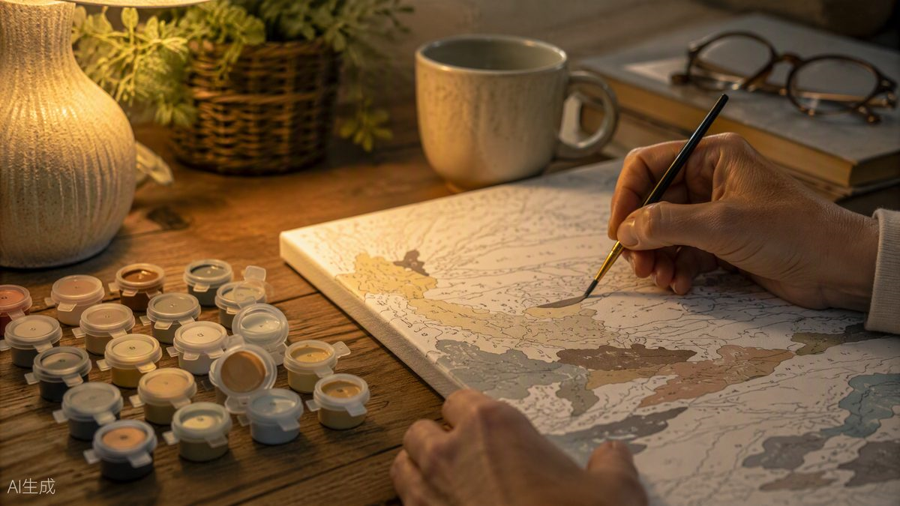
The most common objection adults raise before their first paint-by-numbers kit is also the least justified: "I can't paint." That is precisely the problem the format removes — every shape on the canvas carries a number, every number matches a pre-mixed paint, and the image emerges section by section. For beginners, paint by numbers is less a test of talent than an exercise in patience, and a genuinely screen-free way to spend an evening. This beginner's guide to your first numbered canvas covers the full path from unboxing to the final touch-up; here is the condensed, source-verified version.
Unboxing: what a complete kit contains
A complete kit saves beginners from hunting for supplies. According to the official product pages of Festede, a Hungarian workshop that manufactures numbered kits in Budapest, a standard set includes a 40×50 cm canvas — stretched on a wooden frame or rolled, depending on the option — four brushes of different widths, pre-mixed numbered acrylic paints, an A3 printed reference sheet and a PDF of the numbered canvas sent by email. That PDF is more useful than it looks: if you paint over a number or lose track of a tiny region, the digital reference lets you zoom in and recover it. A Hungarian beginner's walkthrough of the first numbered canvas confirms the same contents for local readers.
Picking a design you will actually finish
The single biggest beginner mistake is starting too complex. Festede uses its own five-level scale, from "very easy" designs with fewer than 500 numbered areas up to "very hard" compositions with more than 2,500. For a first canvas, the lower half of the scale is the sensible choice: larger areas, more forgiving edges, and a finished result in days rather than months. Gift-buyers should weigh the recipient's patience over the image's beauty — a stunning 2,800-area landscape can become a burden. A Hungarian guide to choosing a first paint-by-numbers kit without stress offers a practical rule: if you cannot distinguish individual numbered areas in the product preview photo, the kit is probably too detailed for a first attempt. A deeper look at how difficulty levels work explains the segment-count logic in detail.
Setting up and painting: the habits that matter
You need less than you think: a stable table, decent light, a jar of water for rinsing brushes, paper towels, and a plate or piece of foil as a drying station. Tape the reference sheet somewhere visible. Right-handed painters often start at the top-right corner so a resting hand never drags across wet paint; left-handed painters work from the top-left.
Technique comes down to a handful of habits, described consistently across the reviewed Hungarian beginner's guide to numbered painting. Work one colour at a time across the whole canvas — it keeps the brush rhythm consistent and avoids constant rinsing. Many painters begin with the darkest shades so lighter colours can cleanly cover overruns at the edges. Use the fine brush for borders and small cells, wider brushes for fills, and let each section dry before painting its neighbour. If a number shows through a light colour, a second thin coat solves it. A toothpick works surprisingly well for the tiniest cells. If a pot dries slightly, a single drop of water, gently stirred, usually restores a workable consistency — add sparingly, because over-thinned acrylic loses its covering power.
Colours can also deceive the eye mid-process. A patch that looks wrong in isolation often resolves once neighbouring areas are filled in; this simultaneous-contrast effect is normal, so finish a region before judging it.
When something goes wrong
Paint running out before the canvas is finished is the classic frustration. Festede's published FAQ addresses it directly: the company sends extra paint free of charge within two months if a colour runs short, and its 50-day exchange or money-back guarantee covers hesitant first-timers. Acrylic stains on fabric are hard to remove once dry, so wear older clothes or an apron. And if the finished piece shows a few visible brush transitions, remember that slight texture is the hand-painted character — it distinguishes your canvas from a printed poster. The manufacturer behind these terms has its own documented path from a kitchen-table operation to a proper workshop, told in this case study of how the Festede workshop was built.
Your first evening, planned
The founder has noted in interviews that the brand's buyers are predominantly adults — consistent with a broader rise in hands-on, screen-free hobbies since 2020. To begin well: choose an easy design with large areas, clear a table for ninety minutes, photograph the blank canvas for reference, and paint section number one. Expect the first session to feel slow, the middle sessions to flow, and the smallest cells at the end to test your patience. Check the webshop for current designs, difficulty ratings and guarantee terms — then open the first pot. The rest follows on its own.
this is a subheading
this is a heading
Lorem ipsum dolor sit amet, consectetur adipiscing elit, sed do eiusmod tempor incididunt ut labore et dolore magna aliqua. Massa sapien faucibus et molestie ac. Nulla facilisi morbi tempus iaculis urna id volutpat. Sit amet justo donec enim diam vulputate ut. Tempor orci dapibus ultrices in iaculis nunc sed.
Pharetra convallis posuere morbi leo urna. Non quam lacus suspendisse faucibus interdum posuere lorem ipsum. Accumsan tortor posuere ac ut consequat semper viverra nam libero. Fusce id velit ut tortor pretium.
© Copyright Közigazgatási jog